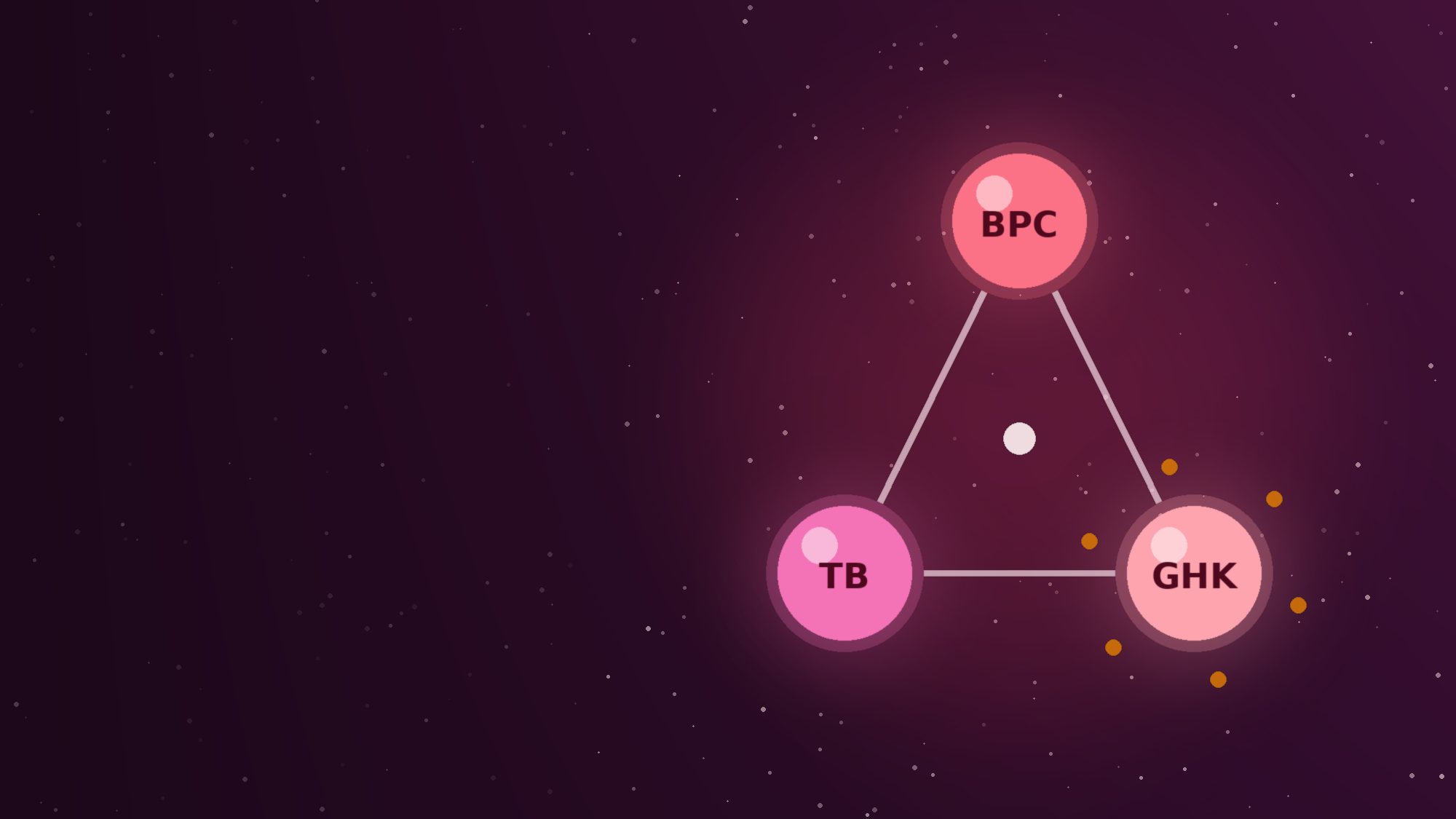
Some research peptides are sold alone. Others are packed together in one vial, on the theory that they help each other. The Glow Blend is one of the best known of these mixes. This guide looks at its three ingredients one by one, explains the reasoning behind the pairing and is honest about how much of it has actually been tested.
The Glow Blend brings together BPC-157, TB-500 and GHK-Cu, three peptides that turn up again and again in laboratory work on healing. Each was discovered by a different team, in a different decade, for a different reason. What links them is that all three have been studied in the way the body closes wounds and rebuilds damaged tissue.
Healing is not one event but a chain of steps. Fresh blood vessels have to grow into the damaged area, cells have to travel there and multiply, and new collagen has to be laid down and slowly organised. In animal and cell studies, each of the three peptides seems to act mostly on a different link in that chain. Putting them together is an attempt to cover the whole sequence at once.
That is the theory. In practice, no published study has tested the three peptides together, so any extra benefit from mixing them is a hypothesis rather than a result. The pages that follow separate the evidence for each ingredient from the open questions about the Glow Blend.
| What it is | A ready-made mix of three research peptides in a single vial |
| Ingredients | BPC-157, TB-500 and GHK-Cu |
| Form | A dry, freeze-dried powder |
| Shared theme | Each has been studied in wound and tissue repair |
| The reasoning | Each ingredient appears to act on a different stage of healing |
| Tested as a mix? | No, only the individual peptides have published data |
| Status | Not licensed as a medicine in the EU, the UK or the US |
This guide describes research; it does not encourage anyone to use these peptides. Research-grade blends are not made for human consumption. If you are dealing with an injury, a skin problem or slow healing, please see a doctor.
 English
 Español
 Deutsch
 Français
 Svenska
 Dansk
 Norsk
 Nederlands
 Polski
 Čeština
 Português
 Ελληνικά
 Italiano